
In-House vs Third-Party Coliving Property Management (Real Cost Breakdown)
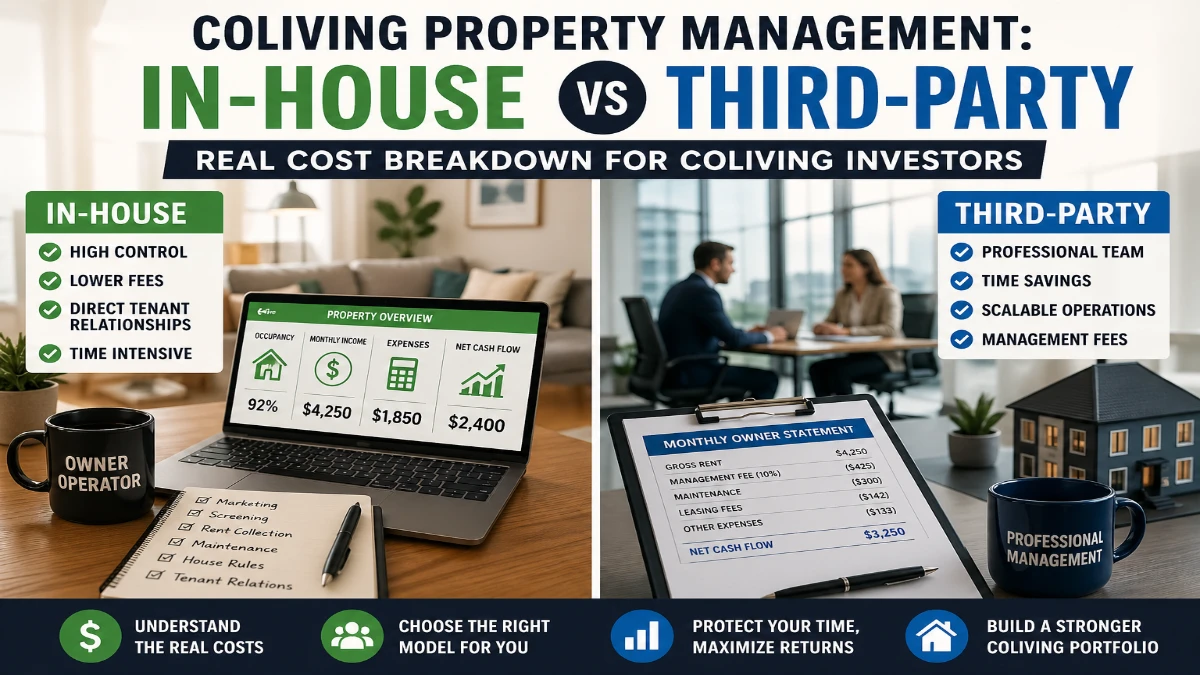
Ask ten coliving investors what’s caused them the most pain in their portfolio, and nine of them will say the same thing: management.
Not the market. Not the financing. Not even tenant issues — those are a symptom. The root cause, almost every time, is a management structure that wasn’t designed for coliving.
After 500+ property analyses and years of operating CMG Properties — Coliving Management Group — across the Boston market, I’ve seen both sides of this decision play out across dozens of portfolios. Self-management that scaled beautifully. Third-party management that quietly destroyed returns. And every combination in between.
This post gives you the real cost breakdown — not the advertised fees, but the actual total cost of each approach — so you can make the right decision for your portfolio.
For investors evaluating operations alongside underwriting, see our guide on-
https://colivingcashflow.com/coliving-deal-underwriting
Why Coliving Management Is Fundamentally Different
Before we compare approaches, let’s establish why coliving management can’t be treated like traditional property management.
In a traditional single-family rental, your management tasks are relatively simple: collect one rent payment, respond to one tenant’s maintenance requests, and re-lease the unit every 12–24 months.
Coliving multiplies every one of those tasks by the number of rooms in the property — and adds a layer of complexity that traditional rental management doesn’t face at all: shared living dynamics.
You’re not just managing leases. You’re managing a household.
What coliving management actually involves:
- Room-level lease administration (4–8 leases per property)
- Individual rent collection and tracking per tenant
- Shared space maintenance and cleanliness enforcement
- House rules communication and compliance
- Conflict mediation between housemates
- Higher-frequency unit turns (more tenant turnover than traditional)
- Individual room marketing and lead management
- Furnished unit management (in many coliving models)
- Platform management if using PadSplit or similar services
A conventional property manager handles none of these well by default. Which is why choosing the right management structure — and the right operator — is the single highest-leverage decision you make after acquisition.
For operational systems, also see
https://colivingcashflow.com/coliving-operations-exit-strategy
Option 1: In-House (Self-Management)
Self-managing your coliving property means you — or a dedicated member of your team — handle all operational responsibilities directly.
What You’re Actually Taking On
Leasing and Marketing: You’re filling individual rooms, not whole units. That means creating room listings, responding to inquiries, screening applicants, conducting showings, executing leases, and coordinating move-ins — potentially multiple times per month across multiple rooms.
Rent Collection: You’re collecting from 4–8 tenants per property, tracking individual payments, following up on late rent, and managing payment disputes.
Maintenance Coordination: Maintenance requests come in at the room level and the house level. You’re triaging, dispatching vendors, following up, and managing shared-space issues that no single tenant “owns.”
Tenant Relations: Shared housing generates interpersonal dynamics. Noise disputes. Cleanliness disagreements. Conflict between housemates. These land with you — the manager — and require thoughtful handling to preserve occupancy.
Administrative: Lease renewals, house rule updates, move-out inspections, security deposit management, and financial record-keeping.
The True Cost of Self-Management
Most investors calculate self-management cost as zero — because they’re not writing a check to a management company. That’s the wrong frame.
The real cost of self-management is time × opportunity cost.
| Task | Est. Monthly Hours (1 Property) |
|---|---|
| Leasing / vacancy marketing | 3–6 hrs |
| Rent collection and follow-up | 1–2 hrs |
| Maintenance coordination | 2–4 hrs |
| Tenant communication | 2–4 hrs |
| Administrative (leases, docs) | 1–2 hrs |
| Total | 9–18 hrs/month |
At a conservative $75/hour opportunity cost (what your professional time is worth), that’s $675–$1,350/month in real cost — on a single property.
Add a second property and those hours don’t double — they triple, because cross-property coordination compounds the complexity.
Additional hidden costs of self-management:
- Property management software subscriptions ($50–$150/month)
- Legal/lease template costs ($200–$500 upfront)
- Tenant screening service fees ($15–$40/applicant)
- Mistakes: wrong lease clauses, improper security deposit handling, fair housing violations — each potentially costing thousands
For landlord-tenant compliance best practices see-
https://www.consumerfinance.gov/
When Self-Management Makes Sense
- You have a genuine interest in operations and want to learn the model from the inside
- You are managing 1–2 properties and building systems for eventual scale
- You are house hacking and live at or near the property
- You have a reliable local team (handyperson, cleaner) already in place
- Your market has limited quality third-party coliving management options
For investors starting with smaller assets, pair this with
https://colivingcashflow.com/how-to-analyze-coliving-properties
Option 2: Third-Party Property Management
Hiring a property management company means outsourcing day-to-day operations to an external team in exchange for a management fee — typically a percentage of collected rents.
What You Should Expect
A quality coliving-specific property manager should handle everything listed above — leasing, rent collection, maintenance coordination, tenant relations, and administrative functions — and deliver you a clean monthly statement with a net income deposit.
The critical qualifier: coliving-specific. A general property management company that primarily manages single-family or traditional multifamily rentals will not manage your coliving asset well, regardless of their fee structure.
The True Cost of Third-Party Management
Published fees (what they advertise):
- Management fee: 8–12% of collected gross rents
- Leasing/placement fee: 50–100% of one month’s room rent per placement
- Maintenance markup: 10–20% on vendor invoices
- Lease renewal fee: $100–$250 per renewal
On a 5-room property at $4,250 gross rent, annual cost estimate:
| Fee Type | Est. Annual Cost |
|---|---|
| Management fee (10%) | $5,100 |
| Leasing fees (2 turns/yr @ $850/room) | $1,700 |
| Maintenance markup (10% on $3,000 repairs) | $300 |
| Renewal fees (3 renewals @ $150) | $450 |
| Total Published Cost | $7,550/year |
That’s approximately $629/month — or about 14.8% of gross rents when all fees are factored in.
Hidden costs of bad third-party management:
- Extended vacancy from poor marketing: $850+/room/month
- Deferred maintenance leading to larger repair bills
- High turnover from poor tenant screening or conflict mismanagement
- Owner involvement required anyway when manager underperforms
The most expensive property manager isn’t the one who charges 12%. It’s the one who charges 8% and costs you 20% of your gross revenue in preventable vacancy and turnover.
When Third-Party Management Makes Sense
- You are a busy professional who genuinely cannot allocate 10–15 hours/month per property
- You manage 3+ properties and need to protect your time
- You want to scale without hiring an internal operations team
- You have found a manager with demonstrated coliving or shared housing experience
- You are investing in a market where you don’t live
Side-by-Side Comparison
| Factor | In-House | Third-Party |
|---|---|---|
| Monthly cost (1 property) | $675–$1,350 (time cost) | $500–$750 (fees) |
| Time required | 9–18 hrs/month | 1–2 hrs/month |
| Control | High | Low–Medium |
| Scalability | Limited (time-constrained) | High |
| Quality risk | Depends on your skills | Depends on operator |
| Best for | 1–2 properties, hands-on investors | 3+ properties, passive investors |
| Requires coliving expertise | From you | From them |
The Hybrid Model: Best of Both Worlds
Many experienced coliving investors operate a hybrid model — one that’s worth understanding if you’re building beyond a single property.
The hybrid structure:
- You build and own the systems: lease templates, house rules, screening criteria, vendor relationships, financial reporting structure
- A part-time local property coordinator (employee or contractor) handles day-to-day operations
- You maintain strategic oversight: approving budgets, reviewing financials, making key tenant decisions
This model typically costs 6–8% of gross revenue in coordinator time — less than a full management company — while maintaining tighter control and operational consistency than a fully outsourced model.
It’s most effective when you’re managing 3–6 properties in a single market and can justify a part-time hire.
The Decision Framework
Ask yourself these four questions:
- How many hours per month can I realistically commit? If the honest answer is fewer than 5, third-party management is your only viable option. Self-managing a coliving property on 3 hours a month leads to deferred maintenance, unaddressed vacancy, and tenant conflict that compounds.
- Do I have coliving management expertise — or am I willing to build it?
https://colivingcashflow.com/3-cs-of-coliving
Self-management without operational knowledge of shared housing is a costly education. If you’re new to the model, either hire a coliving-specialist manager or commit to the learning curve with a single property.
- What is my portfolio growth plan?
https://colivingcashflow.com/coliving-market-analysis
If you intend to own 5+ properties within 3 years, build your management infrastructure for scale from the start. That means third-party or hybrid — not self-management that becomes a ceiling.
- Can I find a qualified coliving-specific manager in my market? This is the real constraint. In many markets, qualified coliving property managers are scarce. If you cannot find a demonstrated operator with shared-housing expertise, self-management with strong systems may be better than outsourcing to a general PM who will mismanage the asset.
Working With CMG Properties
CMG Properties — Coliving Management Group — manages coliving assets across the Greater Boston market. Our operational model is built specifically for room-by-room shared housing: individual lease management, room-level marketing, shared-space protocols, and owner-facing financial reporting designed for coliving investors.
If you’re building a portfolio in the Boston area or want to discuss management best practices for your market, connect with us here.— Clara Arroyave, MBA Founder, Coliving Cashflow | CMG Properties | 500+ properties analyzed
About the Author
Clara is a coliving expert, capital raiser, and CEO with 500+ deals analyzed across the United States. She is the founder of ColivingCashflow.com, a platform for impact-minded investors building coliving portfolios that deliver both strong financial returns and measurable social value. Connect at [email protected].
FAQs: Coliving Property Management (In-House vs Third-Party)
1. What is coliving property management?
Coliving property management involves operating shared housing properties on a room-by-room basis, including leasing, rent collection, maintenance coordination, tenant communication, shared-space management, and conflict resolution. It is typically more operationally intensive than traditional rental management.
2. How is coliving property management different from traditional property management?
Unlike traditional rentals with one lease per unit, coliving often involves multiple leases per property, higher tenant turnover, shared-space oversight, and housemate dynamics. This requires a more specialized management approach.
3. Is self-managing a coliving property worth it?
Self-management can be worth it for investors with 1–2 properties, hands-on operators, or those building systems before scaling. It offers control and can reduce outsourced fees, but it comes with significant time and operational demands.
4. What are the hidden costs of self-managing coliving properties?
Hidden costs may include:
- Time and opportunity cost
- Property management software
- Tenant screening expenses
- Legal documentation costs
- Compliance mistakes
- Vacancy losses from inefficient operations
These costs are often underestimated.
5. How much do third-party coliving property managers charge?
Most third-party coliving managers charge:
- 8–12% management fee
- Leasing or placement fees
- Maintenance markups
- Renewal fees
Total effective management costs can often exceed the advertised fee.
6. Is third-party management better for scaling a coliving portfolio?
Yes, many investors use third-party management or hybrid systems when scaling beyond a few properties, because self-management often becomes a bottleneck.
7. What should I look for in a coliving property manager?
Look for:
- Experience managing shared housing
- Room-by-room leasing expertise
- Tenant conflict management systems
- Strong occupancy and retention performance
- Transparent reporting
- Vendor and maintenance systems
General property managers without coliving experience may underperform.
8. What is the hybrid coliving management model?
A hybrid model combines owner oversight with local operational support, often using a coordinator or small internal team. It can offer more control than full outsourcing while reducing workload.
9. When does self-management stop making sense?
Self-management often becomes difficult when:
- You own 3+ properties
- You have limited time
- You invest remotely
- Operations become inconsistent
- Growth is being constrained by management workload
At that point, outsourced or hybrid models may be more effective.
10. What are the biggest risks of poor coliving management?
Poor management can lead to:
- High turnover
- Vacancy losses
- Tenant conflict
- Deferred maintenance
- Lower cash flow
- Damaged property reputation
In many cases, management issues impact returns more than acquisition mistakes.
11. Can traditional property managers manage coliving properties?
Some can, but many traditional property managers are not built for room-by-room operations. Investors often benefit from working with coliving-specific operators instead.
12. Which is cheaper: in-house or third-party management?
It depends. Self-management may appear cheaper, but once time costs, operational mistakes, and scaling limitations are considered, third-party management may be more cost-effective for some investors.
13. What is the best management model for new coliving investors?
For many beginners, self-managing one property can help build operational knowledge. Others prefer using a specialized third-party manager to reduce mistakes while learning the model.
14.How do I decide between in-house vs third-party management?
Consider:
- Your available time
- Portfolio size
- Management experience
- Growth goals
- Quality managers available in your market
The best structure depends on both economics and operational fit.
15. Does better property management improve coliving returns?
Yes. Strong management can improve:
- Occupancy
- Retention
- Cash flow
- Tenant experience
- Expense control
Ready to Build Your Coliving Portfolio?
Clara Arroyave works with investors to scale profitable coliving portfolios. Book your advisory session today.
Explore Advisory Tiers