
Step-by-Step Process to Find Profitable Coliving Properties
By Clara | Coliving Expert, Capital Raiser & CEO
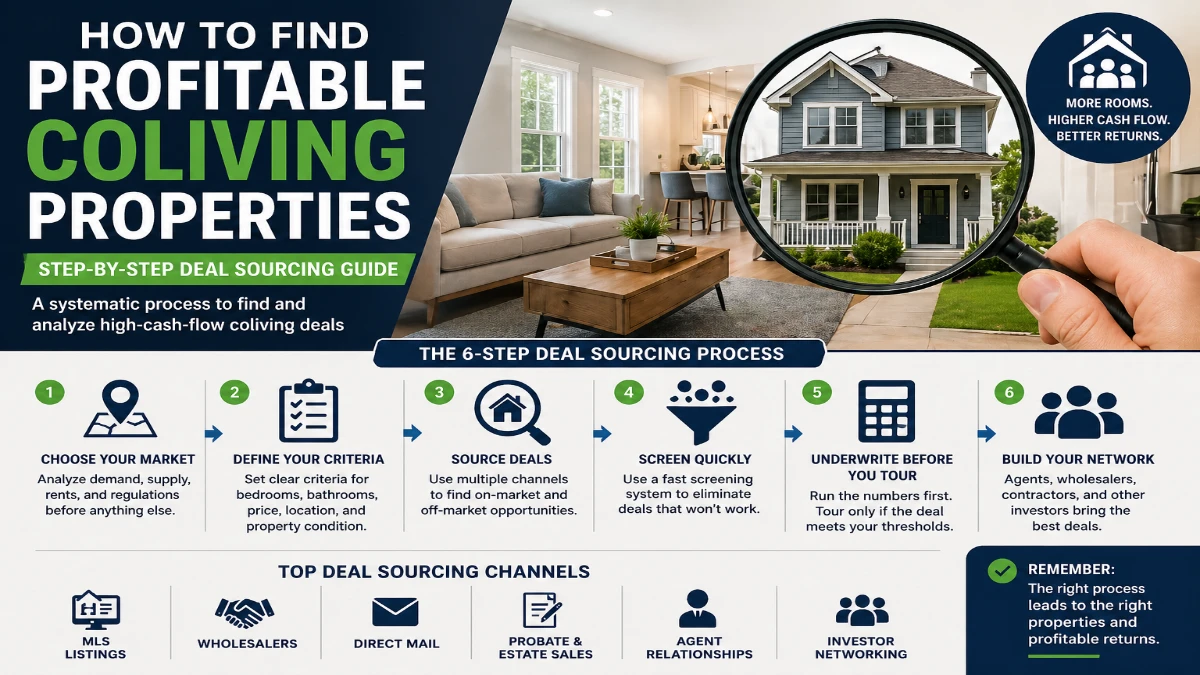
The most common question I get from investors who want to enter the coliving space isn’t about financing or management or tenant screening.
It’s this: How do I find the right property?
After analyzing more than 500 coliving properties across 21+ markets, I can tell you that finding a profitable coliving deal is less about luck and more about a repeatable process. The investors who struggle to find deals are usually skipping steps — jumping from “I want to invest in coliving” directly to scrolling Zillow with no clear criteria in mind.
That’s not deal sourcing. That’s hope.
This guide walks you through the exact step-by-step process I use — and teach inside the 90-Day Coliving Accelerator — to systematically identify, screen, and source profitable coliving properties in any market.
What Makes a Property “Coliving-Ready”?
Before you can source the right deal, you need to know what you’re looking for. Coliving-ready properties share a specific set of physical and financial characteristics that make them well-suited for room-by-room leasing.
Physical criteria:
- 3–7 bedrooms — fewer than 3 limits revenue; more than 7 increases management complexity significantly
- Bedroom-to-bathroom ratio — ideally 1 bathroom per 1–2 bedrooms; 4 beds / 1 bath is a management nightmare
- Functional common spaces — a kitchen, living room, and common areas that are usable and comfortable, not just technically present
- Adequate bedroom size — rooms should accommodate a bed, desk, and personal storage comfortably; under 80 sq ft is difficult to rent
- Separate bedrooms — open floor plans and studio configurations don’t work for coliving
- Parking — market-dependent, but often important to tenant retention
Location criteria:
- Proximity to employment centers, hospitals, universities, or transit
- Neighborhood safety and walkability (tenants sharing a space care more about neighborhood quality than single-household renters)
- Zoning that permits multi-tenant occupancy (verify before you underwrite)
Financial criteria:
- Purchase price that supports positive cash flow at market room rents
- Room rents that exceed whole-unit rent by at least 30% (otherwise the management premium isn’t justified)
- Operating expense ratio below 45% of EGI on a stabilized basis
For a deeper breakdown of evaluating deal viability, see:
https://colivingcashflow.com/how-to-analyze-coliving-properties
Step 1: Choose Your Market Before You Choose Your Property
The most expensive mistake in deal sourcing is finding a property you love in a market that doesn’t support the coliving model.
Market selection comes first. Always.
What to analyze in your target market:
Demand indicators:
- High concentration of single-person households (census data)
- Large workforce populations in hospitality, healthcare, service industries
- Significant student or young professional populations
- Active listings on Furnished Finders, Roomies.com, Facebook Housing groups (existing demand = proven market)
High concentration of single-person households (census data —https://www.census.gov/)
Supply indicators:
- Current number of room listings relative to demand signals
- PadSplit market availability and average room rates (if applicable to your model)
- Competition from purpose-built coliving operators (indicates demand; also sets the price ceiling)
Financial indicators:
- Average room rents relative to acquisition costs (the higher this ratio, the better the market economics)
- Median home prices that allow for cash-flowing acquisitions at conventional financing
- Rent growth trends year-over-year
Regulatory indicators:
- Local zoning ordinances on occupancy limits and rooming houses
- State-level coliving or shared housing legislation
- Landlord-tenant law favorability
Run this analysis before you look at a single listing. Markets I’ve seen work consistently well for coliving include mid-tier cities with large healthcare or service workforces — Greater Boston suburbs, Houston MSA, Memphis, Jacksonville, and markets near major university systems.
For a full market evaluation framework, see:
https://colivingcashflow.com/coliving-market-analysis
Step 2: Define Your Property Criteria in Writing
Before you open Zillow, Realtor.com, or MLS access, write down your exact property criteria. This sounds simple and gets skipped constantly.
Your written criteria should include:
- Target bedroom count range (e.g., 4–6 bedrooms)
- Maximum purchase price (based on your financing capacity and cash flow requirements)
- Minimum bathroom count
- Geographic boundaries (specific zip codes, neighborhoods, or radius from employment centers)
- Property condition tolerance (turnkey vs value-add vs heavy renovation)
- Lot requirements if relevant (parking, yard)
Written criteria do two things: they prevent you from talking yourself into a bad deal because you liked the kitchen, and they make your conversations with agents and wholesalers immediately productive because you can articulate exactly what you’re looking for.
Step 3: Source Deals Across Multiple Channels
Profitable coliving properties don’t exclusively come from the MLS. The best deals often come from channels most investors aren’t working.
Channel 1: MLS / On-Market Listings Start here for market familiarization and to build your price/value calibration. Filter for your bedroom count criteria and run initial screens. On-market deals in competitive markets are often overpriced for coliving use — but not always, particularly on properties that have been sitting due to condition issues that your renovation budget can address.
Channel 2: Wholesalers Wholesalers acquire distressed properties under contract and sell the contract to investors. The best coliving deals often come from wholesale — properties in need of significant renovation that the retail market prices incorrectly. Build relationships with active wholesalers in your target market and communicate your criteria clearly. Consistency matters here: wholesalers route deals to buyers who close, not buyers who kick tires.
Channel 3: Direct Mail and Driving for Dollars Target large single-family homes in your target neighborhoods — specifically properties showing deferred maintenance, extended time on market, or absentee ownership (out-of-state owners often found through county tax records). A direct mail campaign targeting 4–6 bedroom homes in specific zip codes is one of the most reliable off-market sourcing strategies in residential real estate.
Channel 4: Probate and Estate Sales Large older homes — often the ideal physical footprint for coliving — frequently come to market through probate. Estate attorneys and probate court records are underutilized sourcing channels for larger residential properties.
Channel 5: Agent Relationships Work with a real estate agent who understands investment property — ideally one familiar with the coliving or shared housing model. A well-briefed agent with MLS access and strong relationships can get you pre-market deal flow before properties hit Zillow. If you’re working with an agent who doesn’t understand your criteria, you’re wasting both of your time.
Channel 6: Networking Other coliving investors are not your competition — they’re your network. Connect with local REIA groups, PadSplit investor meetups, and online coliving investing communities. Deals, referrals, and off-market opportunities circulate within networks before they ever reach public channels.
Step 4: Build a Fast Initial Screening System
You will look at far more properties than you buy. The goal of initial screening is to quickly eliminate properties that can’t work — so you spend your deep underwriting time only on viable candidates.
60-Second Screen:
- Does the bedroom count meet your criteria? (If not → skip)
- Is the purchase price within range for the market’s room rents? (Use the rough rule: monthly gross room revenue should be ≥ 1% of purchase price)
- Does the bathroom configuration work? (If 4 beds / 1 bath with no addition potential → flag)
- Is it in your target geography?
Properties that pass the 60-second screen get a 15-minute underwrite. Properties that pass the 15-minute underwrite get a full analysis.
The 1% Rule for Coliving: Unlike traditional rentals where the 1% rule (monthly rent ≥ 1% of purchase price) is rarely achievable, coliving often makes it possible — because room rents stack. A $300,000 property generating $3,200/month in gross room rents clears the threshold. Use it as a first-pass filter, not a final decision criterion.
Step 5: Underwrite Before You Tour
This is the discipline that separates sophisticated coliving investors from everyone else.
Do not tour a property before you’ve run the numbers. Touring creates emotional attachment. Emotional attachment leads to overpaying.
Pre-tour underwriting checklist:
- Pull comparable room rents (Furnished Finders, Roomies.com, local Facebook groups)
- Build a room-level pro forma in the Coliving Calculator
- Estimate renovation costs using cost-per-square-foot benchmarks for your market
- Calculate cash-on-cash return at conservative rent and vacancy assumptions
- Identify the maximum purchase price that delivers your minimum cash-on-cash threshold
Only tour properties where the numbers work at your conservative assumptions. Then the tour is about validating or adjusting your renovation estimate — not falling in love with a property.
Step 6: Build Your Sourcing Network Intentionally
Great deal flow is a byproduct of great relationships. The investors who consistently find good coliving deals have built a network that brings opportunities to them — they’re not constantly hunting.
Your sourcing network should include:
- 2–3 active wholesalers in your target market
- 1–2 investment-focused real estate agents with MLS access
- A title company familiar with investment transactions
- A contractor who can provide rapid renovation estimates
- A property inspector you trust to give you honest condition assessments
- Other coliving investors (for referrals and off-market tips)
Build this network before you need it. A relationship established when you’re not in a hurry is worth 10x one built under pressure of a deal deadline.
For scaling your portfolio and operations after acquisition, see:
https://colivingcashflow.com/coliving-operations-exit-strategy
Red Flags: Properties That Look Like Coliving Deals But Aren’t
Not every large house is a good coliving property. Here’s what to walk away from:
🚩 Insufficient bathroom ratio with no addition potential A 6-bedroom house with 1 bathroom and no structural path to adding more is an operational disaster. Tenant dissatisfaction and turnover will be constant.
🚩 Bedroom sizes under 80 sq ft Rooms that can’t physically accommodate a bed, desk, and wardrobe will not command market room rents and will attract only the most price-sensitive tenants — increasing turnover.
🚩 Fundamentally incompatible floor plan Some houses have layouts where every path to the kitchen runs through another tenant’s bedroom. Common-space access needs to work for shared living.
🚩 HOA restrictions on occupancy HOAs frequently prohibit multi-tenant or rooming house operations. Confirm HOA rules before underwriting any HOA property for coliving use.
🚩 Purchase price that only works at top-of-market rents If your pro forma only works when you assume maximum achievable rents with zero vacancy, the deal doesn’t work. Underwrite to conservative assumptions and let the upside be upside.
About the Author
Clara is a coliving expert, capital raiser, and CEO with 500+ deals analyzed across the United States. She is the founder of ColivingCashflow.com, a platform for impact-minded investors building coliving portfolios that deliver both strong financial returns and measurable social value. Connect at [email protected].
FAQs
1. How do you find profitable coliving properties?
You can find profitable coliving properties by following a structured process: selecting the right market, defining property criteria, sourcing deals from multiple channels, screening quickly, and underwriting before touring.
2. What makes a property suitable for coliving?
A good coliving property typically has 3–7 bedrooms, adequate bathrooms, functional shared spaces, and is located near employment centers or transit hubs.
3. Is coliving more profitable than traditional rentals?
Coliving can generate higher income because rent is collected per room instead of per unit. However, it also requires more active management and operational systems.
4. What is the 1% rule in coliving investing?
The 1% rule in coliving means that monthly gross room rent should be at least 1% of the purchase price. It’s used as a quick screening tool for deal viability.
5. Where can I find coliving deals?
You can source deals from:
- MLS listings
- Wholesalers
- Direct mail campaigns
- Probate sales
- Real estate agents
- Networking with other investors
6. Should I underwrite a property before visiting it?
Yes. Underwriting before touring prevents emotional decision-making and ensures you only visit properties that meet your financial criteria.
7. What are the biggest mistakes in coliving deal sourcing?
Common mistakes include:
- Choosing the wrong market
- Not defining criteria clearly
- Overestimating rent
- Ignoring zoning regulations
- Touring properties before analyzing numbers
8. What locations are best for coliving investments?
Strong coliving markets usually have:
- High housing costs
- Large workforce populations
- Universities or hospitals
- Limited affordable housing supply
9. How do I analyze room rental demand?
You can analyze demand using platforms like Furnished Finder, Roomies, and local housing groups, along with census and employment data.
10. What are red flags in coliving properties?
Red flags include:
- Poor bedroom-to-bathroom ratios
- Very small bedrooms
- Bad layout for shared living
- HOA restrictions
- Deals that only work with unrealistic rent assumptions
11. Can beginners invest in coliving properties?
Yes, beginners can start with small single-family homes and scale as they gain experience with operations and deal analysis.
12. How long does it take to find a good coliving deal?
It varies by market and effort, but investors who follow a structured system typically find viable deals within a few months.
Ready to Build Your Coliving Portfolio?
Clara Arroyave works with investors to scale profitable coliving portfolios. Book your advisory session today.
Explore Advisory Tiers