
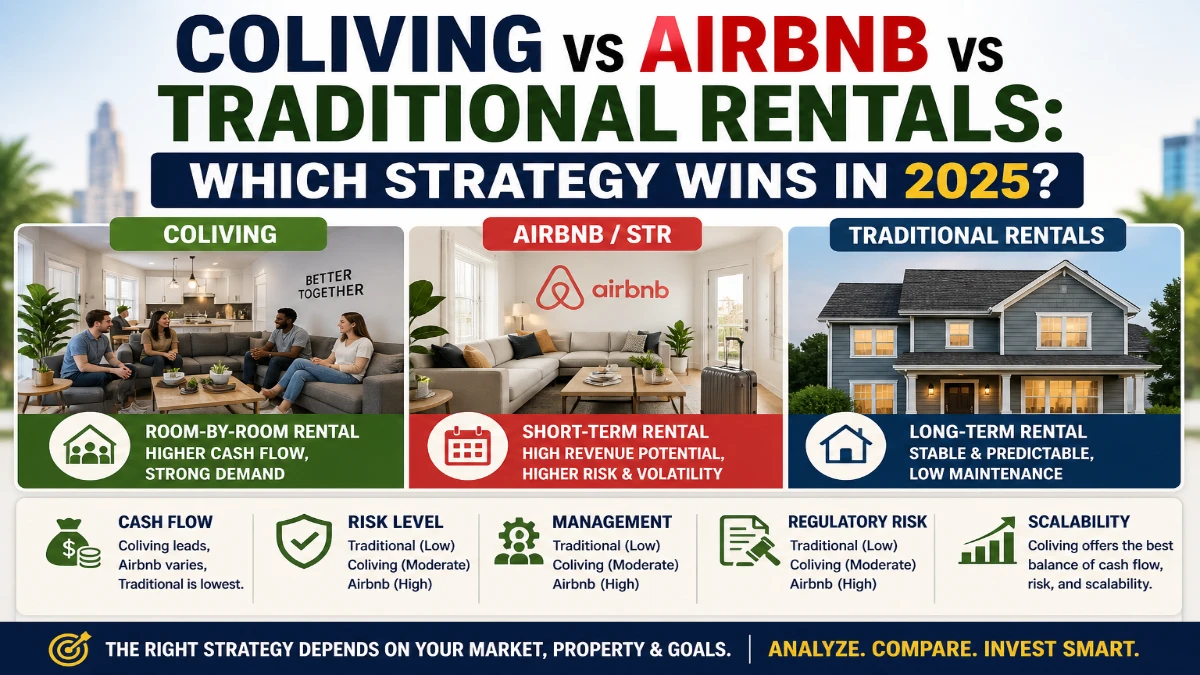
Every real estate investor faces this question eventually: given the same property, the same market, and the same capital — which rental strategy actually produces the best outcome?
It’s not a simple answer. And anyone who gives you a simple answer is either selling a course on one of those strategies or hasn’t actually operated all three.
I’ve analyzed 500+ properties across 21+ markets and advised on over $80 million in portfolios. I’ve underwritten Airbnb projections, run traditional rental analyses, and built coliving pro formas on the same properties — sometimes for the same clients making the strategy decision in real time.
This post gives you an honest, data-grounded comparison of all three across the dimensions that actually matter: cash flow, risk, management intensity, regulatory exposure, and scalability in 2026.
How to Frame This Comparison Fairly
First, a framing note: no single strategy wins in every market, for every investor, on every property type. The right strategy is a function of three variables:
- The market — local rent levels, short-term rental demand, regulatory environment
- The property — physical layout, location, condition, bedroom/bathroom configuration
- The investor — capital position, time availability, risk tolerance, growth goals
We’ll cover all three variables. But first, let’s make sure we’re comparing the same thing.
The Three Strategies: A Quick Overview
Traditional Rental (Long-Term) One household leases the entire property on a 12-month lease. You collect one monthly payment, manage one set of tenant relationships, and have predictable — if modest — cash flow. This is the baseline most investors start from.
Airbnb / Short-Term Rental (STR) The property is rented on a nightly or weekly basis through platforms like Airbnb, Vrbo, or direct booking channels. Revenue potential is high when occupancy is strong. Management intensity and platform dependency are significant factors.
Coliving / Mid-Term Room-by-Room Rental Individual rooms are leased separately to multiple tenants on 30-day to 12-month leases. Revenue is generated from multiple income streams within a single property. Management is more complex than traditional but significantly more stable than STR.
For a deeper breakdown of how coliving works as a model, see:
https://colivingcashflow.com/how-to-analyze-coliving-properties
Cash Flow Comparison
Cash flow is where the three strategies diverge most dramatically — and where most investors’ intuitions are most frequently wrong.
The same 4-bedroom property, three strategies: (Mid-market city, $280,000 purchase price, 7% rate, 25% down)
| Metric | Traditional Rental | Airbnb/STR | Coliving |
|---|---|---|---|
| Gross Monthly Revenue | $2,200 | $4,500* | $3,600 |
| Vacancy/Platform Fees | ($110) | ($900) | ($360) |
| Operating Expenses | ($600) | ($1,800)** | ($950) |
| Monthly Mortgage | ($1,490) | ($1,490) | ($1,490) |
| Net Monthly Cash Flow | ~$0–$200 | ~$310 | ~$800 |
| Cash-on-Cash Return | 0–3% | 3–5% | 10–14% |
*STR revenue assumes strong seasonal market and 75% occupancy **STR operating expenses include cleaning fees, supplies, furnishings depreciation, platform fees, and higher insurance
Important caveats on these numbers:
The Airbnb numbers above reflect a well-performing STR in a market with genuine short-term demand. In markets without tourist or business travel demand, STR occupancy rates drop significantly — and those numbers flip negative fast.
The coliving numbers reflect market room rents with 8% vacancy — achievable in markets with proven coliving demand. In weak coliving markets, these numbers contract.
The traditional rental numbers are the most predictable — and the most consistently modest across markets.
Bottom line on cash flow: In markets where all three strategies are viable, coliving consistently outperforms traditional rentals on cash flow. Airbnb can outperform coliving in peak tourist markets — but with significantly more volatility.
Risk Comparison
Revenue potential without a risk lens is incomplete analysis. Here’s how the risk profiles compare:
Traditional Rental Risk:
- Vacancy risk: Low — 12-month leases provide income predictability
- Tenant risk: Moderate — one bad tenant affects the entire asset
- Market risk: Low — demand for housing is relatively inelastic
- Regulatory risk: Low — traditional rentals face minimal regulatory pressure
- Overall: Lowest risk of the three strategies
Airbnb/STR Risk:
- Vacancy risk: High — occupancy fluctuates with seasons, local events, and platform algorithm changes
- Platform risk: Very high — Airbnb policy changes, search ranking shifts, and account suspensions can eliminate revenue overnight
- Regulatory risk: Very high — STR bans, permit restrictions, and HOA prohibitions have eliminated entire markets since 2022
- Operational risk: High — guest damage, fraudulent bookings, and neighbor complaints are ongoing exposures
- Overall: Highest risk of the three strategies
Coliving Risk:
- Vacancy risk: Moderate — room-level leasing means partial vacancy is common but total vacancy is rare
- Tenant risk: Moderate-to-Low — distributed across multiple tenants; one vacancy doesn’t collapse cash flow
- Market risk: Low-to-Moderate — demand driven by workforce housing needs, which is structural rather than discretionary
- Regulatory risk: Moderate — zoning and occupancy ordinances require due diligence; growing legislative support in many states
- Overall: Moderate risk, with better downside protection than STR and better upside than traditional
The risk-adjusted return picture: Coliving’s risk-adjusted return is consistently stronger than both alternatives. You’re capturing most of the STR upside — without the platform dependency, regulatory exposure, and operational volatility — while generating 5–10x the cash flow of traditional rentals on the same asset.
Management Intensity Comparison
Time is the real cost most real estate income comparisons ignore. Here’s the honest breakdown:
Traditional Rental: 2–4 hours/month per property on a stabilized basis. Lease once, collect monthly, respond to maintenance. Lowest management intensity of the three.
Airbnb/STR: 10–20+ hours/week per property for self-managed operations. Guest communication, check-in coordination, cleaning supervision, supply restocking, review management, and platform optimization are ongoing. Most active STR investors either build a full operational team or burn out within 18 months. Co-host fees (20–30% of revenue) bring this closer to passive — but shrink the financial advantage significantly.
Coliving: For self-managed coliving: 8–15 hours/month per property. For third-party managed coliving with a specialized operator: 1–3 hours/month. Higher than traditional, dramatically lower than STR.
Management conclusion: If your goal is near-passive income, traditional rental wins on management — but loses badly on returns. Coliving with good management infrastructure delivers the returns without the operational weight of STR.
Regulatory Environment in 2026
This dimension has shifted dramatically in the past three years and deserves serious attention.
Traditional Rentals: Regulatory stability is the highest of the three. Eviction moratoriums created temporary disruption during the pandemic, but long-term rental regulations have been relatively stable. Some markets have rent control implications to understand — but the baseline is low regulatory risk.
Airbnb/STR: The regulatory landscape for short-term rentals is actively hostile in a growing number of markets. Since 2022, cities including New York, San Francisco, Phoenix, Nashville, and dozens of others have enacted permit caps, primary residence requirements, or outright STR bans in residential zones. This trend is accelerating, not reversing. Building an STR portfolio in 2026 means building on potentially shifting regulatory ground.
Coliving: Coliving regulation is evolving — but in a favorable direction in many states. New Hampshire passed HB 457 in 2025, explicitly protecting coliving operations statewide. Similar legislative frameworks are under consideration in multiple states. While local zoning compliance remains a due diligence requirement, the macro regulatory trajectory for coliving is more favorable than for STR.
For housing policy data and regulatory insights, see:
Scalability Comparison
Traditional Rental Scalability: Linear and capital-constrained. Each new property requires capital deployment and generates modest incremental cash flow. The scalability ceiling is set by your capital, your debt-to-income ratio, and your willingness to manage increasing operational complexity.
STR Scalability: Technically high — but operationally brutal. Scaling an STR portfolio beyond 3–5 properties without a dedicated team and systems is a full-time job, not a passive investment. Platform dependency also means your entire portfolio faces systemic risk from a single policy change.
Coliving Scalability: The most capital-efficient path to meaningful cash flow. Coliving generates more revenue per dollar of equity deployed than traditional rentals — meaning you reach income milestones faster with the same capital base. Third-party coliving management allows genuine scalability without proportional time investment. The management infrastructure required is more sophisticated than traditional rental management — but once built, it scales.
Which Strategy Fits Which Market
| Market Type | Best Strategy | Why |
|---|---|---|
| Tourist/beach/resort market | STR | Seasonal demand justifies operational intensity |
| Major urban core with STR ban | Coliving | STR not viable; coliving demand strong |
| Mid-tier city, workforce market | Coliving | Best cash flow, structural demand |
| Suburban market, low STR demand | Traditional or Coliving | Depends on acquisition cost vs room rents |
| College town | Coliving | High room-rental demand, natural fit |
| Rural / low-demand market | Traditional | Simplicity > optimization |
For market selection strategy, see:
https://colivingcashflow.com/coliving-market-analysis
Who Each Strategy Is For
Traditional rental is best for: Investors who prioritize simplicity, predictability, and minimal time investment over maximum returns. Excellent as a base layer in a diversified portfolio.
Airbnb/STR is best for: Investors in genuine tourist markets who are willing to build a hospitality operation — or who can afford co-host fees and accept the platform dependency risk. Not a passive investment.
Coliving is best for: Investors who want to maximize cash flow on residential assets, are willing to build operational systems, and want a strategy with strong workforce housing demand tailwinds and growing regulatory support.
The 2026 Verdict
In most residential markets, for most investors with a 5–10 year wealth-building horizon, coliving generates the best risk-adjusted returns.
It outperforms traditional rentals by 5–10x on cash flow per dollar invested. It outperforms STR on risk, stability, regulatory safety, and management intensity. It benefits from structural demographic tailwinds — housing affordability pressure is not going away.
The caveat: coliving requires more upfront education and operational infrastructure than traditional rentals. Investors who skip that work don’t get the returns.
No hype. Just data.
— Clara Arroyave, MBA Founder, Coliving Cashflow | 500+ properties analyzed | $80M+ advised
About the Author
Clara is a coliving expert, capital raiser, and CEO with 500+ deals analyzed across the United States. She is the founder of ColivingCashflow.com, a platform for impact-minded investors building coliving portfolios that deliver both strong financial returns and measurable social value. Connect at [email protected].
FAQs
1. Which rental strategy is most profitable in 2026?
Coliving is often the most profitable in many residential markets due to higher per-room income, while Airbnb can outperform in strong tourist locations. Traditional rentals typically generate the lowest but most stable returns.
2. Is Airbnb more profitable than coliving?
Airbnb can generate higher income in peak tourist markets, but it comes with higher volatility, platform dependency, and regulatory risk. Coliving offers more stable and predictable cash flow in most markets.
3. Why is coliving becoming more popular in 2026?
Coliving is growing due to rising housing costs, increasing demand for affordable housing, and strong workforce housing needs. It provides a cost-effective solution for tenants and higher returns for investors.
4. What are the risks of Airbnb investing?
Airbnb risks include:
- Regulatory restrictions or bans
- Platform dependency
- Seasonal occupancy fluctuations
- Higher operational complexity
- Guest-related damages
5. Are traditional rentals still a good investment?
Yes, traditional rentals remain a solid option for investors seeking stable, low-maintenance income with minimal operational complexity, even though returns may be lower.
6. Which rental strategy requires the least management?
Traditional rentals require the least management, followed by coliving (with systems or third-party management), while Airbnb requires the most active involvement.
7. Is coliving a safer investment than Airbnb?
In many cases, yes. Coliving typically has lower regulatory risk, less volatility, and more stable demand compared to Airbnb.
8. What type of property works best for coliving?
Properties with 3–7 bedrooms, multiple bathrooms, and functional shared spaces in high-demand workforce areas are ideal for coliving.
9. Can I switch between rental strategies for the same property?
Yes, some investors switch between strategies depending on market conditions, regulations, and performance, but it requires planning and compliance with local laws.
10. What is the best rental strategy for beginners?
Traditional rentals are often best for beginners due to simplicity. However, beginners willing to learn operations can start with coliving for higher returns.
11. Which strategy scales the fastest?
Coliving often scales faster than traditional rentals due to higher cash flow per property. Airbnb can scale quickly but requires significant operational systems.
12. How do I choose the right rental strategy?
Consider:
- Your market demand
- Property layout
- Time availability
- Risk tolerance
- Investment goals
The best strategy aligns all five factors.
Ready to Build Your Coliving Portfolio?
Clara Arroyave works with investors to scale profitable coliving portfolios. Book your advisory session today.
Explore Advisory Tiers