
Houston Coliving Investment Guide: High Cash Flow Rental Strategy
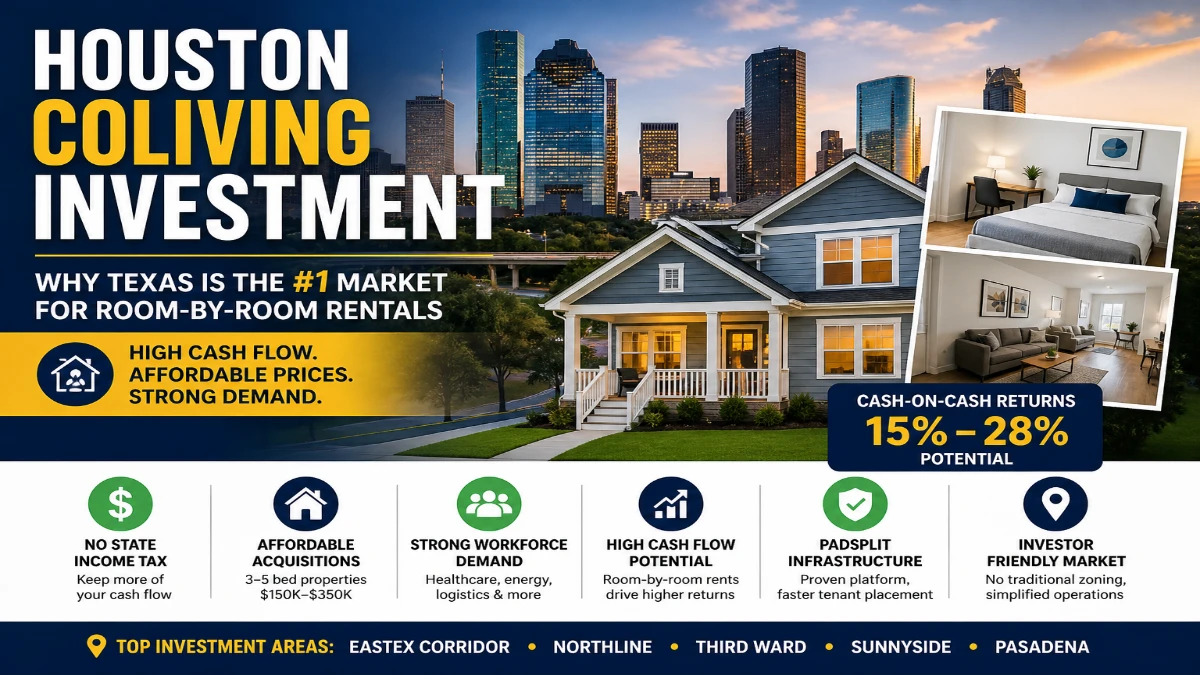
Houston is the best coliving investment market in the United States right now — and most investors aren’t paying attention to it.
That’s not a hot take. It’s what the data shows when you analyze acquisition prices, room-level rents, workforce housing demand, and cash-on-cash returns across 21+ U.S. markets. I’ve modeled GP/LP structures for Houston syndications, underwritten individual deals on Waco Street, Eastex Freeway, and Goodhope Street, and tracked this market through cycles that have tested every major assumption.
The Houston coliving investment thesis holds. Here’s the full breakdown — including real deal numbers, neighborhood analysis, PadSplit intelligence, and the risks you need to underwrite before you buy.
Related:
Best Cities for Coliving Investment in the U.S. (2025 Data Report) |
Free Coliving Investment Tools
Why Invest in Coliving in Houston, Texas?
Most investors dismiss Houston as a secondary market. They’re looking at the wrong metrics.
Houston isn’t a coliving opportunity because it’s glamorous. It’s a coliving opportunity because the fundamental equation — acquisition cost relative to room-level rents relative to operating expenses — produces cash-on-cash returns that coastal markets cannot match.
Here’s what makes Houston structurally superior for coliving:
No state income tax. Texas has zero state income tax. For investors, that’s higher net cash flow relative to equivalent properties in California, New York, or Massachusetts. For tenants — especially workforce earners — it means more disposable income, better rent payment reliability, and lower economic vulnerability.
No traditional zoning. Houston is the largest American city without Euclidean zoning. Deed restrictions and ordinances still apply, but the absence of strict residential zoning simplifies coliving development and conversion significantly compared to cities requiring variances or special use permits.
Affordable acquisitions. Inner-ring Houston neighborhoods offer 3–5 bedroom properties in the $150,000–$350,000 range. In Boston or coastal California, the equivalent property costs $700,000–$1.4 million. Lower entry price means faster cash-on-cash payback and lower capital risk.
Workforce housing demand at scale. Houston’s economy — energy, healthcare, logistics, port operations — produces hundreds of thousands of workers earning $30,000–$60,000/year who need clean, affordable individual room rentals. This is the structural tenant base coliving serves. It doesn’t disappear in a recession.
Deep PadSplit infrastructure. Houston is one of PadSplit’s highest-volume markets nationally. That means faster tenant placement, proven room-level demand data, and an operational platform purpose-built for the coliving model.
Houston Coliving Market Demand Drivers in 2025
The coliving model works best where three conditions converge: high single-person household density, constrained housing affordability, and large workforce populations. Houston delivers on all three.
Single-person households: Approximately 35% of Houston households are single-person — one of the highest rates among major U.S. metros. This is your core coliving tenant pool.
(source: https://www.census.gov).
Renter-majority inner ring: Within 5–10 miles of downtown Houston, renter-occupancy rates exceed 60% in many census tracts. Established rental demand, low ownership-conversion risk.
Texas Medical Center: 106,000+ employees. The largest medical complex in the world generates continuous demand for individual room rentals from residents, nurses, and healthcare support workers near the Midtown, Montrose, and Third Ward corridors.
PadSplit market validation: Houston’s PadSplit volume provides real-time, platform-verified room demand data that traditional market analyses don’t capture. When PadSplit is active and growing in a market, room-level demand is confirmed — not assumed.
Best Neighborhoods for Coliving Investment in Houston
Not all Houston submarkets perform equally for coliving. Here’s where the data points for investors at different capital levels:
Northeast Houston / Near Northside (Eastex corridor) Kashmere Gardens, Denver Harbor, Northside Village. Acquisition range: $120,000–$200,000. PadSplit demand is strong, driven by blue-collar and service-sector workforce. Highest cash-on-cash potential in the metro. Flood zone due diligence is critical here.
Sunnyside / South Union / Third Ward Properties in the $150,000–$280,000 range with strong room demand from the Medical Center workforce and Texas Southern University / University of Houston populations. Gentrification has pushed Third Ward prices higher — southern neighborhoods remain entry-level.
North Houston / Northline $130,000–$220,000 range. Consistent demand from logistics and distribution workers serving the Port of Houston. PadSplit performs well in this corridor.
Outer Ring (Pasadena, Baytown, Humble) $100,000–$180,000 acquisition range. Strong potential returns, but longer tenant placement timelines and higher management complexity with distance from employment centers.
PadSplit Houston Investment Deal Analysis: 1630 Eastex Freeway
Here’s what the coliving underwriting looks like on a representative Northeast Houston deal — a 4-bedroom, 2-bathroom SFR at $175,000.
Revenue (PadSplit model):
| Line Item | Amount |
|---|---|
| 4 rooms × $700/month gross | $2,800 |
| PadSplit platform fee (15%) | ($420) |
| Vacancy (8%) | ($190) |
| Effective Gross Income | ~$2,190/month |
Operating Expenses:
| Line Item | Amount |
|---|---|
| Utilities (included in PadSplit) | $300 |
| Maintenance & repairs | $150 |
| Insurance | $120 |
| Property taxes | $350 |
| Total OpEx | ~$920/month |
Net Operating Income: ~$1,270/month Debt Service (25% down, 7% rate): ~$875/month Net Cash Flow: ~$395/month Cash-on-Cash Return: ~10.8% on $43,750 equity
Well-renovated properties with private bathrooms command $750/month per room and push returns to the 15–17% range. This is a representative — not exceptional — deal for the Eastex corridor.
Houston Coliving Cash Flow: 5-Bedroom Deal Breakdown (Waco Street)
For investors targeting the mid-market segment — properties priced $220,000–$280,000 with direct room leasing rather than PadSplit — the return profile improves meaningfully.
Revenue (direct leasing, 5 rooms):
| Line Item | Amount |
|---|---|
| 5 rooms × $875/month | $4,375 |
| Vacancy (8%) | ($350) |
| Effective Gross Income | ~$4,025/month |
Operating Expenses:
| Line Item | Amount |
|---|---|
| Property management (10%) | $403 |
| Maintenance | $175 |
| Insurance | $130 |
| Property taxes | $500 |
| Utilities/common | $120 |
| Reserves | $150 |
| Total OpEx | ~$1,478/month |
NOI: ~$2,547/month Debt Service ($260K purchase, 25% down, 7%): ~$1,300/month Net Cash Flow: ~$1,247/month Cash-on-Cash Return: ~23% on $65,000 equity
This is the Houston coliving sweet spot — high enough acquisition price to attract quality tenants, low enough to generate strong double-digit returns.
How PadSplit Works for Houston Coliving Investors
PadSplit is the dominant room-rental platform in Houston. Before you build a strategy around it — or around avoiding it — understand the actual mechanics.
What PadSplit handles: Tenant matching, background screening, weekly rent collection, and tenant communication. You don’t fill rooms yourself — PadSplit sources tenants from its platform.
What it costs: Approximately 15% of gross room revenue, plus a weekly fee tenants pay directly to access platform benefits.
Where it works best in Houston: Lower-income inner-ring neighborhoods where the weekly payment model serves tenants who need flexibility, and where room rents run $550–$800/month.
Where it works less well: Higher-end properties targeting professionals who prefer monthly direct leases. Above $850/month per room, direct leasing often outperforms PadSplit financially.
The NOI trade-off: On a 4-bedroom property, PadSplit’s platform fee reduces NOI by $300–$600/month versus direct leasing at equivalent rents. You’re paying for faster placement and reduced management burden.
My recommendation: Use PadSplit for your first 1–2 Houston properties to validate the market and build operational experience. Evaluate direct leasing as you scale and your systems mature.
Houston Coliving Investment Risks: What to Know Before You Buy
Every strong market has real risks. Houston’s are worth understanding before you commit capital.
Flood zone exposure. Hurricane Harvey in 2017 caused catastrophic damage across the Houston MSA. Before acquiring any property, verify FEMA FIRM flood zone designation, review historical flood claims on the specific parcel, and confirm your insurance policy covers flood exposure. Properties in 100-year or 500-year flood plains carry risk that no cash-on-cash return can fully offset.
Deferred maintenance concentration. The most affordable Houston deals frequently carry deferred maintenance — foundation issues, aging HVAC, outdated plumbing. A $160,000 property needing $40,000 in repairs is a $200,000 deal. Underwrite renovation costs explicitly before you make an offer.
Platform concentration risk. Building a portfolio entirely dependent on PadSplit means your cash flow is exposed to platform policy changes, fee structure adjustments, and market coverage decisions made by a third party. Maintain operational capacity to lease rooms directly.
Property tax trajectory. Texas property taxes are among the nation’s highest and have risen significantly in recent years. Always model current assessed value — not the seller’s stated tax — and stress-test your pro forma with a 15% tax increase scenario.
How to Start Coliving Investing in Houston, TX
Houston’s acquisition prices make it accessible at conventional financing terms. Entry is achievable without institutional capital — but it requires discipline.
Step 1 — Validate your submarket. Use PadSplit market data, Furnished Finders, and local Facebook housing groups to confirm room-level demand and achievable rents before you underwrite anything.
Step 2 — Run room-level pro formas. Use the Coliving Calculator to build a deal-specific analysis before making any offer. Never use whole-unit comps for coliving underwriting.
Step 3 — Decide your management model before closing. PadSplit, direct leasing, or hybrid — your choice affects NOI, financing qualification, and operational workload from Day 1.
Step 4 — Build your sourcing network. The best Houston deals don’t stay on Zillow. Connect with local wholesalers, PadSplit operators, and investment-focused agents who can get you pre-market access.
For deeper Houston deal analysis — including the full GP/LP syndication structure — connect with the Coliving Cashflow advisory team.
No hype. Just data.
— Clara Arroyave, MBA Founder, Coliving Cashflow | Houston market analyst | 500+ properties analyzed | $80M+ advised
About the Author
Clara is a coliving expert, capital raiser, and CEO with 500+ deals analyzed across the United States. She is the founder of ColivingCashflow.com, a platform for impact-minded investors building coliving portfolios that deliver both strong financial returns and measurable social value. Connect at [email protected].
Frequently Asked Questions: Houston Coliving Investment
Is Houston a good market for coliving investment in 2025?
Yes. Houston consistently ranks as the top U.S. market for entry-level and mid-tier coliving investors based on acquisition affordability, room-level rent potential, workforce housing demand, and PadSplit infrastructure. Cash-on-cash returns of 15–28% are achievable on well-underwritten properties.
What is the average room rent for coliving in Houston?
Room rents vary by submarket and property quality. PadSplit room rents run $550–$800/month in lower-income inner-ring neighborhoods. Direct-lease room rents in higher-demand areas run $750–$1,050/month. Well-renovated properties with private bathrooms command premiums at both ends.
Does PadSplit operate in Houston?
Yes. Houston is one of PadSplit’s highest-volume markets nationally, with thousands of room placements completed across the MSA. The platform is strongest in Northeast Houston, North Houston, and South/Third Ward corridors.
What are the flood risks for coliving investment in Houston?
Flood risk is real and property-specific. Always verify the FEMA FIRM flood zone designation for any parcel before acquiring. Properties outside the 100-year flood plain carry significantly lower risk. Flood insurance is essential in Houston regardless of zone designation.
How much money do I need to invest in Houston coliving?
A typical entry-level Houston coliving investment at $175,000 purchase price with 25% down requires approximately $43,750 in equity plus closing costs (~$4,500) and renovation budget (varies by condition, typically $10,000–$40,000). Total capital requirement: $60,000–$90,000 depending on property condition.
Should I use PadSplit or lease rooms directly in Houston?
Both models work. PadSplit offers faster placement and lower management burden at the cost of a 15% platform fee that compresses NOI. Direct leasing produces higher NOI at the cost of greater management involvement. Most experienced Houston coliving investors start with PadSplit and transition to direct leasing selectively as they scale.
Ready to Build Your Coliving Portfolio?
Clara Arroyave works with investors to scale profitable coliving portfolios. Book your advisory session today.
Explore Advisory Tiers