
Cambridge vs Somerville vs Boston Coliving Investment Comparison (2025 Guide)
Greater Boston is one of the most expensive real estate markets in the United States. It is also one of the most consistently profitable for coliving investors who understand the market — and one of the most unforgiving for those who don’t.
I’m not writing this from a distance. I operate CMG Properties — Coliving Management Group — in this market. I manage coliving units at 43 Clifton Street, 305 Hurley Street, and 154 Magazine Street in Cambridge. I’ve run rent roll analyses on these properties, managed the tenant relationships, handled the maintenance, and built the operating systems that make shared housing work in one of America’s most competitive rental environments.
What follows is the local intelligence that national market reports miss — including where the best returns are, where the best tenants are, and why the right answer to “Cambridge vs Somerville vs Boston” depends entirely on your investor profile.
Best Cities for Coliving Investment in the U.S. (2025 Data Report) → https://colivingcashflow.com/best-cities-coliving-investment-usa/
Coliving Property Management: In-House vs Third-Party → https://colivingcashflow.com/coliving-property-management/
Why Invest in Coliving in Greater Boston?
Before comparing the three cities, let’s establish the structural case for Greater Boston as a coliving market.
Demand is perpetual, not cyclical. Boston’s economy is anchored by institutions that generate consistent, year-round room rental demand regardless of broader economic conditions: Harvard, MIT, Tufts, Boston University, Northeastern, Massachusetts General Hospital, Brigham and Women’s, Beth Israel Deaconess, Dana-Farber, and the Kendall Square biotech corridor. Medical residents, postdoctoral researchers, graduate students, and early-career biotech professionals all need individual room rentals — and they represent a tenant pool that renews itself continuously.
Supply is structurally constrained. Massachusetts has some of the most restrictive housing development regulations in the country. New production has lagged population and employment growth for decades. The result: vacancy rates persistently near historic lows in Cambridge and inner Boston neighborhoods. Room rental demand routinely exceeds available supply in desirable submarkets. (Source: https://www.census.gov)
Room rents are premium. Where Houston yields $650–$900/month per room and Memphis yields $550–$800/month, Greater Boston yields $1,100–$1,800/month per room in well-managed coliving properties. The premium reflects market constraint, tenant quality, and proximity to world-class employers.
The trade-off: higher acquisition prices produce lower cash-on-cash returns relative to Southern markets. The value proposition in Greater Boston is not year-1 cash flow maximization. It is acquiring an appreciating, income-generating asset in one of the most supply-constrained rental markets in the country.
Cambridge MA Coliving Investment: Returns, Rents, and Neighborhoods:
Cambridge is the premium tier of the Greater Boston coliving market — the highest demand, highest rent, and most competitive submarket to enter.
Why Cambridge commands the premium:
Cambridge is home to Harvard and MIT — two institutions whose combined enrollment, staff, and affiliated researchers number in the tens of thousands annually. Add the Kendall Square biotech corridor (Biogen, Novartis, Pfizer, and hundreds of smaller companies), the Cambridge Innovation Center ecosystem, and proximity to Massachusetts General Hospital, and you have a tenant demand base that is effectively recession-proof.
Room rents in Central Square, Inman Square, Porter Square, and Harvard Square consistently achieve $1,300–$1,800/month for well-configured, professionally managed coliving rooms. A 4-bedroom Cambridge coliving property generating four rooms at $1,400/month produces $5,600/month gross — more than double the equivalent Houston property.
What CMG Properties operational data shows:
Across our Cambridge portfolio — 43 Clifton, 305 Hurley, 154 Magazine — we track occupancy rates consistently above 92%, average tenancies of 8–14 months, and room rents that have grown 4–6% annually over the past three years. Tenant profiles are overwhelmingly graduate students, medical residents, and early-career researchers. Maintenance costs are lower than comparable Southern market properties. Turnover costs are manageable at current tenancy lengths.
The Cambridge coliving tenant is self-sufficient, income-stable, and low-friction relative to markets with more transient or economically stressed populations.
Cambridge acquisition reality:
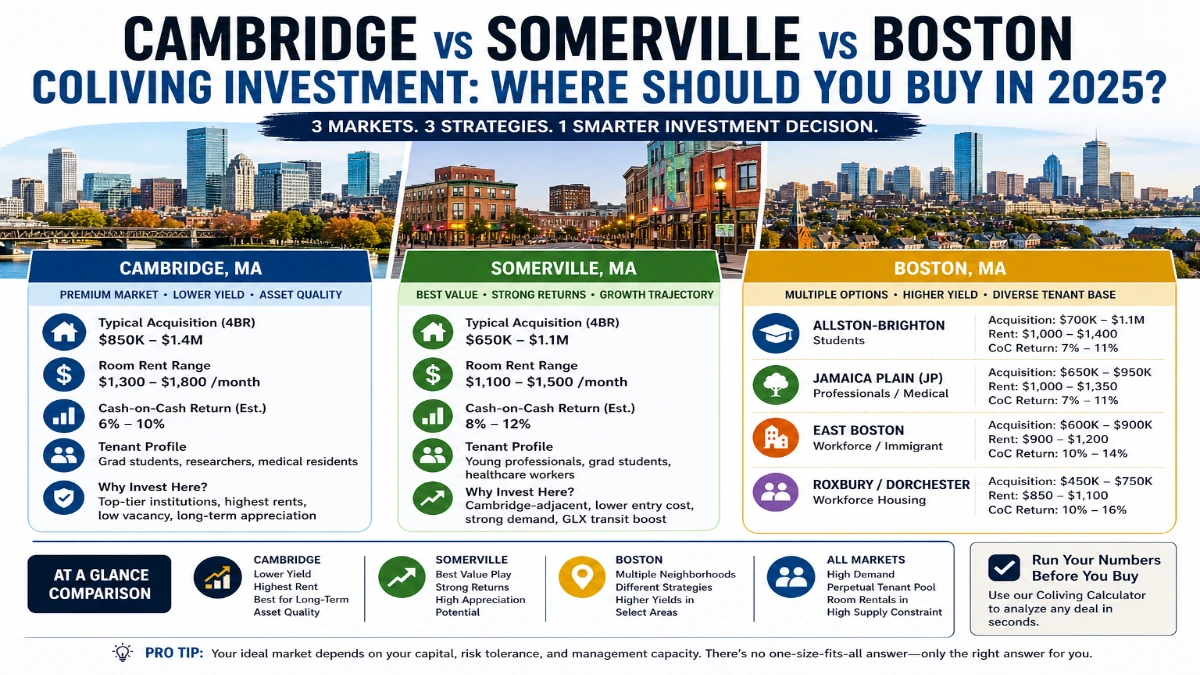
A 4-bedroom multifamily or large single-family in Central Square or Inman Square costs $850,000–$1.4 million. Cash-on-cash returns run 6–10%. These are strong numbers for the Boston market — modest compared to Houston or Memphis.
Cambridge is for investors who prioritize long-term asset quality and appreciation alongside income, not maximum year-1 yield.
Best Cambridge neighborhoods for coliving: Central Square, Inman Square, Porter Square, Cambridgeport, Agassiz.
Somerville MA Coliving Investment: The Value Play in Greater Boston
Somerville is where experienced Greater Boston investors look when Cambridge prices have moved beyond their target range — and where the best risk-adjusted returns in the metro currently sit.
Why Somerville makes sense:
Somerville sits directly adjacent to Cambridge. Union Square is a 10-minute walk from MIT. Davis Square is a 15-minute Red Line ride to Harvard. The same tenant pool that fills Cambridge coliving properties — graduate students, researchers, healthcare workers, early-career professionals — actively chooses Somerville when Cambridge pricing is too high or availability is too low.
The Green Line Extension (GLX), with Union Square and Lechmere branches opened in 2022, has meaningfully improved Somerville’s transit connectivity. Union Square has emerged as one of the highest-demand neighborhoods in the metro — with rising commercial activity, new residential development, and a neighborhood trajectory that consistently points toward appreciation.
Somerville numbers:
Acquisition prices: $650,000–$1.1 million for a 4-bedroom property — 20–30% less than Cambridge equivalents. Room rents: $1,100–$1,500/month depending on neighborhood and property quality. Cash-on-cash returns: 8–12% on well-underwritten properties — higher than Cambridge, still premium relative to most U.S. markets.
Somerville offers Cambridge-quality demand at a meaningful acquisition discount. For investors with a 10+ year hold horizon, the appreciation trajectory combined with strong room rents makes this the value play in Greater Boston.
Best Somerville neighborhoods:
Union Square (highest demand, best GLX access), Davis Square, Magoun Square, East Somerville (more affordable entry, strong upside).
Watch for: Somerville has become more active in tenant protection policy. Understand local landlord-tenant ordinances before you acquire them. Operationally navigable — but requires more legal awareness than Southern markets.
Best Boston Neighborhoods for Coliving Investment in 2025
Boston proper offers distinct coliving opportunities across several neighborhoods — each with a different demand profile, acquisition cost, and operational character.
Allston-Brighton Highest-density student neighborhood in Greater Boston. Boston University’s main campus runs through Brighton. Room rents: $1,000–$1,400/month. Acquisition prices for 4-bedroom properties: $700,000–$1.1 million. Challenge: higher turnover driven by September-to-September academic leasing cycles. Management systems must accommodate coordinated summer turnovers.
Jamaica Plain (JP) Professional community with strong Healthcare/Longwood Medical Area demand. Lower turnover than Allston. Room rents: $1,000–$1,350/month. Acquisitions: $650,000–$950,000. Strong long-term appreciation trajectory. Lower management friction than student-heavy neighborhoods.
East Boston Most affordable Boston entry point with real coliving demand. Acquisitions: $600,000–$900,000. Room rents: $900–$1,200/month. Large immigrant and working-class professional population. Silver Line and Blue Line provide direct downtown access. Different tenant profile than Cambridge or JP — but genuine, consistent room demand.
Roxbury / Dorchester Workforce housing coliving profile. Acquisitions: $450,000–$750,000. Room rents: $850–$1,100/month. Strongest cash-on-cash returns in Boston proper. Requires more active management oversight than premium neighborhoods. Higher returns reflect higher operational requirements.
Cambridge vs Somerville vs Boston: Side-by-Side Coliving Comparison
| Dimension | Cambridge | Somerville | Boston (Allston/JP) | Boston (Eastie/Rox) |
|---|---|---|---|---|
| Typical acquisition (4BR) | $850K–$1.4M | $650K–$1.1M | $700K–$1.1M | $450K–$900K |
| Room rent range | $1,300–$1,800 | $1,100–$1,500 | $1,000–$1,400 | $850–$1,200 |
| Cash-on-cash return (est.) | 6–10% | 8–12% | 7–11% | 10–16% |
| Tenant profile | Grad students, researchers, residents | Professionals, grad students | Students, young professionals | Workforce, immigrant, service |
| Turnover rate | Low–Moderate | Low | Moderate–High (Allston) / Low (JP) | Moderate |
| Appreciation trajectory | Strong | Strong–Very Strong | Moderate–Strong | Moderate |
| Management complexity | Low–Moderate | Moderate | Moderate | Moderate–High |
| Best for investor type | Asset-quality focused, long hold | Value-add, appreciation play | Yield + appreciation balance | Highest yield, active management |
Which Greater Boston Coliving Market Fits Your Investor Profile?
Cambridge — You prioritize asset quality, tenant stability, and long-term appreciation. You have the capital to enter at $850K+ and a 10–20 year investment horizon. Cash-on-cash return of 6–10% is acceptable in exchange for a premium, defensible asset.
Somerville — You want Cambridge-quality demand at a meaningful acquisition discount. You’re willing to manage slightly more regulatory complexity in exchange for stronger returns and one of the best neighborhood appreciation trajectories in Greater Boston.
Boston (Allston/JP) — You want Greater Boston exposure at a lower entry point, accept more management variability in exchange for better initial yields, and want neighborhoods with long-term appreciation potential.
Boston (Eastie/Roxbury) — You’re optimizing for the highest cash-on-cash returns in the metro and are willing to manage a more operationally intensive asset. You have or will build a strong local management infrastructure.
None of these is the wrong answer. The right choice is determined by your capital, risk tolerance, and management capacity.
How to Invest in Coliving in Greater Boston
Greater Boston is not a market you enter without local operational infrastructure. Tenant protections, condo conversion dynamics, permit requirements, and neighborhood-level rental market dynamics require experience that national market research doesn’t provide.
What you need before acquiring:
- A local real estate attorney familiar with Massachusetts landlord-tenant law
- A property management structure designed for coliving — not adapted from traditional rental management
- Lease templates and house rules built for Massachusetts compliance
- A local maintenance vendor network (plumbers, electricians, general contractors) before your first tenant issue
CMG Properties manages coliving assets across the Cambridge market with operational systems built specifically for Greater Boston shared housing. For investors evaluating Boston-area acquisitions, advisory support is available through Coliving Cashflow.
— Clara Arroyave, MBA Founder, Coliving Cashflow | 500+ properties analyzed | $80M+ advised
About the Author
Clara is a coliving expert, capital raiser, and CEO with 500+ deals analyzed across the United States. She is the founder of ColivingCashflow.com, a platform for impact-minded investors building coliving portfolios that deliver both strong financial returns and measurable social value. Connect at [email protected].
Frequently Asked Questions: Greater Boston Coliving Investment
Is Cambridge or Somerville better for coliving investment?
Both are strong markets. Cambridge offers higher room rents ($1,300–$1,800/month) and premium tenant quality at higher acquisition prices ($850K–$1.4M for a 4BR). Somerville offers 20–30% lower acquisition prices with similar demand drivers and room rents of $1,100–$1,500/month — making it the better risk-adjusted opportunity for most investors.
What are typical room rents for coliving in Cambridge MA?
Well-configured, professionally managed coliving rooms in Central Square, Inman Square, and Porter Square achieve $1,300–$1,800/month. Properties with en-suite or private bathrooms command premiums at the upper end. CMG Properties Cambridge portfolio data shows 4–6% annual room rent growth over the past three years.
What cash-on-cash return can I expect from coliving in Greater Boston?
Cambridge: 6–10%. Somerville: 8–12%. Boston (Allston/JP): 7–11%. Boston (East Boston/Roxbury): 10–16%. These ranges reflect well-underwritten properties with appropriate management infrastructure.
What is the biggest risk of coliving investment in Massachusetts?
Massachusetts has strong tenant protection laws — eviction processes are longer and more expensive than Southern markets. Improper lease structures or tenant screening violations can expose investors to significant legal liability. Working with a Massachusetts-experienced attorney and coliving-specific management is essential, not optional.
Does PadSplit operate in Boston or Cambridge?
PadSplit’s strongest markets are in the South and Midwest. In Greater Boston, direct room leasing via Furnished Finders, word-of-mouth, and building tenant networks is the primary model for coliving operators. CMG Properties uses direct leasing with structured tenant screening across our Cambridge portfolio.
How do I find a coliving property manager in Cambridge or Boston?
General property managers are not equipped for coliving in Greater Boston. Look specifically for operators with shared-housing experience, room-level lease management capability, and familiarity with Massachusetts landlord-tenant law. CMG Properties manages coliving assets in Cambridge — contact us at colivingcashflow.com/advisory.
Ready to Build Your Coliving Portfolio?
Clara Arroyave works with investors to scale profitable coliving portfolios. Book your advisory session today.
Explore Advisory Tiers