
How to Use Coliving Investment Tools Step-by-Step Guide
The investors who succeed in coliving are not the most talented. They’re the most systematic.
They validate markets before they tour properties. They run room-level pro formas before they make offers. They screen tenants before they hand over keys. And they use tools designed specifically for coliving — not spreadsheets borrowed from single-family rental analysis that miss half the relevant variables.
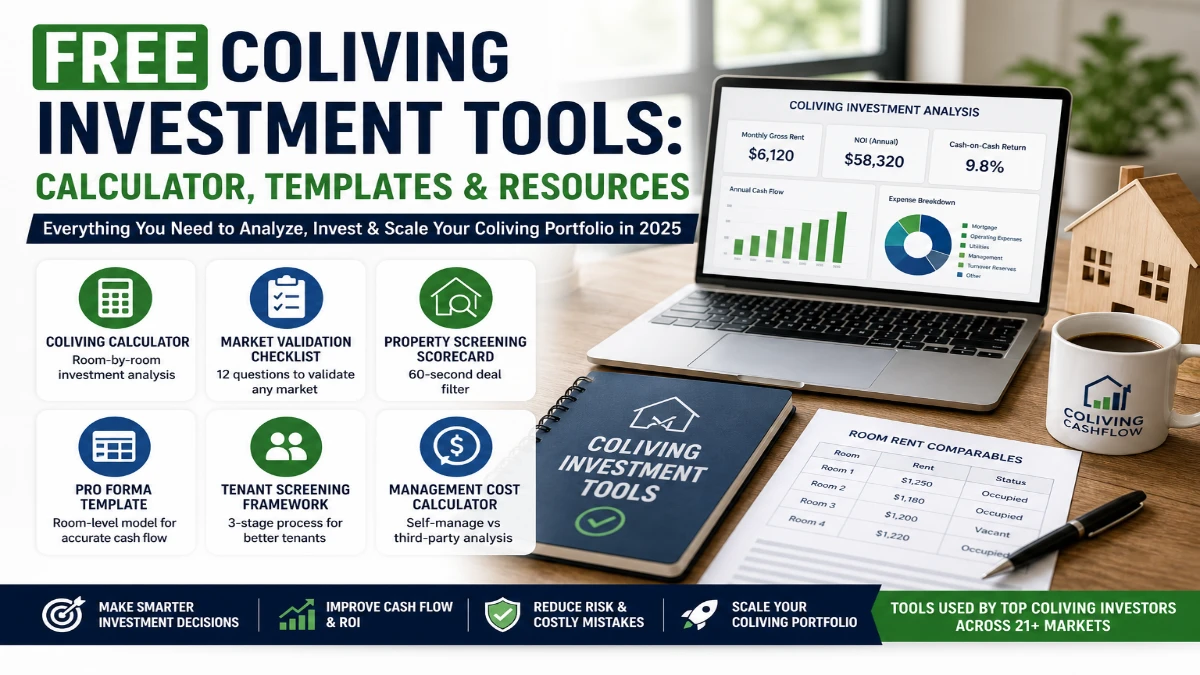
After analyzing 500+ properties across 21+ markets and advising on $80M+ in portfolios, I’ve built a toolkit of calculators, frameworks, and templates that I use in my own business and teach inside the 90-Day Coliving Accelerator. This page puts all six free resources in one place — with instructions for how to use each one and how they fit together as a system.
How My Clients Go From 0 to Cash-Flowing in 90 Days → https://colivingcashflow.com/
Why Coliving Investing Requires Different Analysis Tools
Generic real estate calculators and templates are built for conventional rentals — one household, one monthly payment, one lease. When you apply them to coliving, two things happen: you either dramatically underestimate revenue (because you used whole-unit comps instead of room-level rents) or you dramatically overestimate performance (because you ignored platform fees, per-room vacancy, and turnover costs).
How to Find Profitable Coliving Properties (Step-by-Step Deal Sourcing Guide)
Coliving has more variables than traditional rental analysis:
- Room-level rents — each room priced individually, not aggregated as a single unit rent
- Per-room vacancy — a room vacant for two weeks affects your NOI differently than whole-unit vacancy
- Platform fees — PadSplit’s 15% fee is a major NOI variable that generic tools ignore
- Turnover costs — more frequent tenant rotation means explicit per-room turnover budgets
- Shared utility allocation — utilities are usually landlord-paid in coliving, not tenant-paid
- Management structure — in-house vs. third-party vs. PadSplit each produce different NOI profiles
The tools below were built for these variables. Each one is purpose-built for coliving — not adapted from a traditional rental framework.
Coliving Calculator: Free Room-by-Room Investment Analysis
What it is: A purpose-built underwriting tool that analyzes coliving properties at the room level. Input purchase price, room count, individual room rents, vacancy, operating expenses, and financing terms. Output: NOI, cash-on-cash return, DSCR, and a 5-year projection.
What makes it different: Every mainstream real estate calculator uses a single monthly rent figure. The Coliving Calculator is built from the ground up for room-by-room analysis — because coliving math is fundamentally different from traditional rental math.
How to use it in 5 steps:
- Enter your target property’s purchase price and bedroom count
- Input comparable room rents pulled from Furnished Finders, PadSplit, or local listings
- Set vacancy at 8–10% for stabilized coliving (not the 5% standard for single-family)
- Enter your financing terms
- Review NOI, cash-on-cash return, and 5-year projection — then stress-test at lower rents
Free Coliving Market Validation Checklist (12 Questions)
What it is: A structured 12-question framework for evaluating whether a city or neighborhood can support the coliving model — before you analyze a single property. Built from the same criteria I use across 21+ markets.
The 12 questions answer:
- What percentage of households are single-person?
- What is the renter-occupancy rate in target neighborhoods?
- What are actual comparable room rents — not whole-unit comps?
- Is PadSplit active in this market?
- What is the average days-on-market for room listings?
- What are the local zoning and occupancy ordinances?
- Are there deed restrictions affecting multi-tenant occupancy?
- What is the median household income vs. target room rent ratio?
- What are the primary employers within commuting distance?
- What is the housing supply pipeline (new construction pressure)?
- What is the unemployment rate and economic stability profile?
- What is the exit market — who buys coliving-configured properties here?
A market that answers all 12 questions favorably is worth underwriting at the property level. A market with 4+ red-flag answers is one to skip before you waste time on deal analysis.
What percentage of households are single-person? (Source: U.S. Census Bureau — https://www.census.gov
Coliving Property Screening Scorecard: 60-Second Deal Filter
What it is: A 10-point rapid-assessment tool for evaluating whether a specific property is worth deep underwriting — or whether to pass immediately.
The 10-point screen:
| Criterion | Pass | Fail Signal |
|---|---|---|
| Bedroom count in target range | ✓ | Outside 3–7 BR |
| Bathroom ratio (1:2 minimum) | ✓ | 4BR / 1BA with no addition path |
| Bedroom minimum size (80+ SF each) | ✓ | Multiple rooms under 80 SF |
| Functional kitchen and common spaces | ✓ | Layout prevents shared use |
| Adequate parking for market | ✓ | No parking in car-dependent market |
| Zoning confirmed for multi-tenant | ✓ | Unconfirmed — requires immediate check |
| No HOA restriction on coliving | ✓ | HOA docs not reviewed |
| Passes 1% gross rent test | ✓ | Monthly room rents < 1% of purchase price |
| Within 30 min of employment center | ✓ | Isolated from jobs/transit |
| No known structural/environmental red flags | ✓ | Foundation, flood zone, contamination |
Properties scoring below 7/10 pass to the skip pile. Properties scoring 8–10 get full underwriting in the Coliving Calculator.
Free Coliving Pro Forma Template: Room-Level Investment Model
What it is: A pre-built Excel/Google Sheets template structured specifically for room-by-room coliving analysis — not adapted from a single-family template, but built from scratch for how coliving properties generate and spend revenue.
What’s included:
- Individual room rent inputs (up to 8 rooms, each priced separately)
- Per-room vacancy modeling
- PadSplit platform fee line (toggle on/off)
- Shared utility allocation
- Operating expense detail: management, maintenance, insurance, taxes, utilities, reserves, turnover costs
- NOI and cap rate calculation
- Debt service and cash flow after debt
- Cash-on-cash return
- 5-year projection with rent growth and expense escalation
Why this template matters: Most investors adapt a standard rental spreadsheet for coliving and miss PadSplit fees, per-room turnover costs, shared utility allocation, and room-level vacancy. This template has every coliving-specific line item already built in — so you can’t accidentally miss the variables that separate a good deal from a bad one.
Coliving Tenant Screening Framework: 3-Stage Process
What it is: A structured screening protocol designed specifically for shared housing — not adapted from single-family rental screening.
Related guide: https://colivingcashflow.com/passive-income-coliving/
Why coliving screening is different: In a traditional rental, one problematic tenant affects one household. In coliving, one problematic tenant affects every housemate — generating conflict, increasing turnover, and damaging the property’s reputation on platforms like PadSplit. The tenant-placement decision has compounding consequences in shared housing that don’t exist in conventional rentals.
The 3 stages:
Stage 1 — Financial Qualification:
- Income: minimum 2.5–3x monthly room rent (verified via pay stubs or bank statements)
- Credit: minimum score threshold (600+ typical; adjust by market)
- Rental history: 2+ years with no evictions in last 5 years
- Employment: current verifiable income source
Stage 2 — Background Check:
- Criminal background (state-specific guidelines apply — know your jurisdiction)
- Sex offender registry
- Prior eviction record (separate from credit report in many states)
Stage 3 — Lifestyle Compatibility Interview (15 minutes): This is what most investors skip — and it’s the most valuable screen in coliving. A structured conversation covering:
- Work schedule (day shift vs. night shift matters for house noise dynamics)
- Cooking frequency and kitchen habits
- Cleanliness standards and expectations
- Guest policy comfort level
- Prior shared housing experience
- Noise sensitivity and quiet hours preferences
Tenants who pass all three stages have measurably lower turnover, fewer house conflicts, and better payment reliability than those screened only on financial criteria.
Coliving Management Cost Calculator: Self-Manage vs Third-Party
What it is: A calculator that determines the true total cost of self-management versus third-party management on a coliving property — including your time, published management fees, leasing fees, and maintenance markups.
The insight most investors miss: Self-management “costs nothing” because you’re not writing a check to a management company. But your time has value. At $75/hour opportunity cost, 12 hours/month of self-managing a coliving property = $900/month in real cost. Third-party management at 10% of a $3,600/month gross rent = $360/month in published fees.
The math often surprises investors — especially once leasing fees, maintenance markups, and extended vacancy from management mistakes are factored in.
Inputs the calculator uses:
- Number of properties/rooms
- Your hourly opportunity cost
- Estimated self-management hours per month
- Local management fee (% of collected rents)
- Average leasing fee per turnover event
- Estimated maintenance markup percentage
How to Use Coliving Investment Tools in Sequence
These tools are most powerful when used in order. Here’s the system:
Before you look at any property: → Market Validation Checklist — confirm the market can support coliving
When you find a potential deal: → Property Screening Scorecard — 60-second pass/fail → If it passes: Coliving Calculator + Pro Forma Template — full underwriting
Before you make an offer: → Stress-test the Calculator at conservative assumptions → Management Cost Calculator — decide your management structure based on numbers
When you’re placing tenants: → Tenant Screening Framework — all 3 stages, every placement
When evaluating your portfolio: → Return to the Coliving Calculator to model refinancing, 1031 exchange, or next acquisition scenarios
— Clara Arroyave, MBA Founder, Coliving Cashflow | 500+ properties analyzed | $80M+ advised
About the Author
Clara is a coliving expert, capital raiser, and CEO with 500+ deals analyzed across the United States. She is the founder of ColivingCashflow.com, a platform for impact-minded investors building coliving portfolios that deliver both strong financial returns and measurable social value. Connect at [email protected].
Frequently Asked Questions: Coliving Investment Tools
Is the Coliving Calculator really free?
Yes. The Coliving Calculator at colivingcashflow.com/calculator is free to use with no commitment required. Pro features and advanced scenarios are available in the paid tier.
What makes the Coliving Calculator different from other real estate calculators?
Most real estate calculators use a single monthly rent input. The Coliving Calculator is built for room-by-room analysis — separate rent inputs per room, per-room vacancy, PadSplit fee toggle, shared utility allocation, and coliving-specific operating expense line items. It produces NOI, cash-on-cash, DSCR, and a 5-year projection calibrated for room-by-room leasing.
Do I need accounting or financial experience to use these tools?
No. The tools are designed for investors at all experience levels. The Coliving Calculator walks you through each input with explanations. The templates include embedded formulas — you enter your data, the math is done for you.
Can I use the Pro Forma Template for PadSplit deals?
Yes. The Pro Forma Template includes a PadSplit fee toggle that allows you to model the platform fee (~15% of gross revenue) and compare PadSplit vs. direct leasing on the same property.
What’s the next step after using the free tools?
If your free tool analysis shows a deal is worth pursuing, the 90-Day Coliving Accelerator provides structured, guided support through the full investment process — market selection, deal sourcing, underwriting, offer negotiation, management setup, and tenant placement.
Ready to Build Your Coliving Portfolio?
Clara Arroyave works with investors to scale profitable coliving portfolios. Book your advisory session today.
Explore Advisory Tiers